

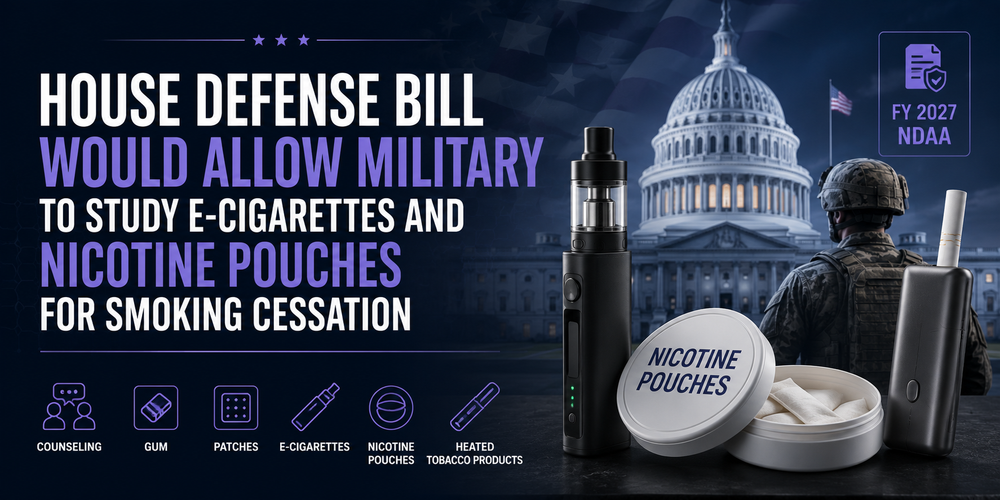
House Defense Bill Would Allow Military to Study E-Cigarettes and Nicotine Pouches for Smoking Cessation
Posted by Alli Boughner on Jul 28th 2026
The U.S. House of Representatives has approved a defense policy bill that could mark a significant shift in how the federal government approaches smoking cessation for active-duty military personnel.
Included in the House version of the Fiscal Year 2027 National Defense Authorization Act (NDAA) is a provision allowing the Department of Defense (DoD) to conduct a one-year pilot program evaluating a broader range of smoking cessation options—including e-cigarettes, nicotine pouches, and heated tobacco products—alongside traditional therapies like counseling, nicotine gum, and nicotine patches.
While the proposal is far from becoming law, it represents one of the clearest acknowledgments by Congress that helping adult smokers quit combustible cigarettes may require more than conventional nicotine replacement therapies alone.
What the House Bill Would Do
Passed by the House on July 22, 2026, H.R. 8800 includes Section 707, which authorizes—but does not require—the Secretary of Defense to establish a one-year smoking cessation pilot program within 180 days of the bill becoming law.
The pilot would be available to active-duty members of the:
- Army
- Navy
- Marine Corps
- Air Force
- Space Force
To qualify, participants must smoke at least one combustible tobacco product per week.
The proposed program would evaluate six different cessation tools:
- Behavioral counseling
- Nicotine gum
- Nicotine patches
- Electronic cigarettes
- Nicotine pouches
- Heated tobacco products
Rather than assuming one approach works best for everyone, the pilot is designed to compare outcomes and determine which options are most effective for helping military personnel transition away from combustible cigarettes.
Why This Matters
For decades, most government-sponsored smoking cessation programs have focused primarily on counseling and pharmaceutical nicotine replacement therapies.
The House proposal recognizes that some adult smokers may benefit from additional alternatives that deliver nicotine without combustion.
The Department of Defense would be required to study which approaches lead to the greatest reductions in cigarette smoking, identify barriers to treatment, and recommend whether the program should continue or expand.
Importantly, the legislation authorizes the pilot—it does not mandate that the Pentagon implement it.
That distinction leaves significant discretion to military health officials if the measure ultimately becomes law.
Smoking Remains a Challenge in the Military
Tobacco use has long been more common among military personnel than in many civilian populations.
According to a Defense Health Agency analysis of military health survey data, cigarette use among active-duty service members ranged between approximately 11% and 18%, with the highest rates found among younger service members between 17 and 24 years old.
Reducing combustible tobacco use remains an important readiness and long-term health objective for the military, making effective cessation programs a continuing priority.
Harm Reduction Continues to Gain Attention
One notable aspect of the House proposal is its inclusion of noncombustible nicotine products alongside traditional cessation methods.
While no nicotine product is risk-free, federal regulators have repeatedly acknowledged that combustible cigarettes pose the greatest health risks because of the toxic chemicals created through burning tobacco.
The FDA has authorized multiple electronic nicotine products and nicotine pouches through the Premarket Tobacco Product Application (PMTA) process after determining they meet the statutory public health standard for marketing.
Although authorization does not mean these products are "safe," it reflects FDA's determination that marketing them is appropriate for the protection of public health under the evidence submitted.
The House language does not endorse any specific product. Instead, it proposes gathering real-world data to better understand which approaches help military smokers successfully move away from cigarettes.
The Proposal Still Faces Significant Hurdles
Despite House approval, the pilot program is far from guaranteed.
The Senate Armed Services Committee's version of the Fiscal Year 2027 NDAA does not include comparable language authorizing the smoking cessation pilot.
Before becoming law, both chambers of Congress must agree on a final version of the legislation during conference negotiations.
Even if the final NDAA retains Section 707, the Defense Secretary would still have discretion over whether to launch the pilot.
Looking Ahead
If ultimately enacted, the pilot could provide valuable evidence about how a wider range of smoking cessation tools performs in one of the nation's largest healthcare systems.
For manufacturers, retailers, and advocates following tobacco harm reduction policy, the proposal is noteworthy because it reflects growing congressional interest in evaluating alternatives to combustible cigarettes using real-world evidence rather than limiting smokers to a single cessation pathway.
Whether the pilot survives the legislative process remains uncertain, but it represents an important policy discussion that could influence future approaches to smoking cessation both within and beyond the military.
Sources
- House-passed FY2027 National Defense Authorization Act (H.R. 8800): https://www.congress.gov/bill/119th-congress/house-bill/8800
- House Armed Services Committee: https://armedservices.house.gov/
- Defense Health Agency – Tobacco and Nicotine Use: https://health.mil/Military-Health-Topics/Health-Readiness/Population-Health/Tobacco-Free-Living
- FDA – Premarket Tobacco Product Applications (PMTA): https://www.fda.gov/tobacco-products/market-and-distribute-tobacco-product/premarket-tobacco-product-applications
- FDA – Authorized Tobacco Products: https://www.fda.gov/tobacco-products/market-and-distribute-tobacco-product/authorized-tobacco-products
- Senate Armed Services Committee: https://www.armed-services.senate.gov/