
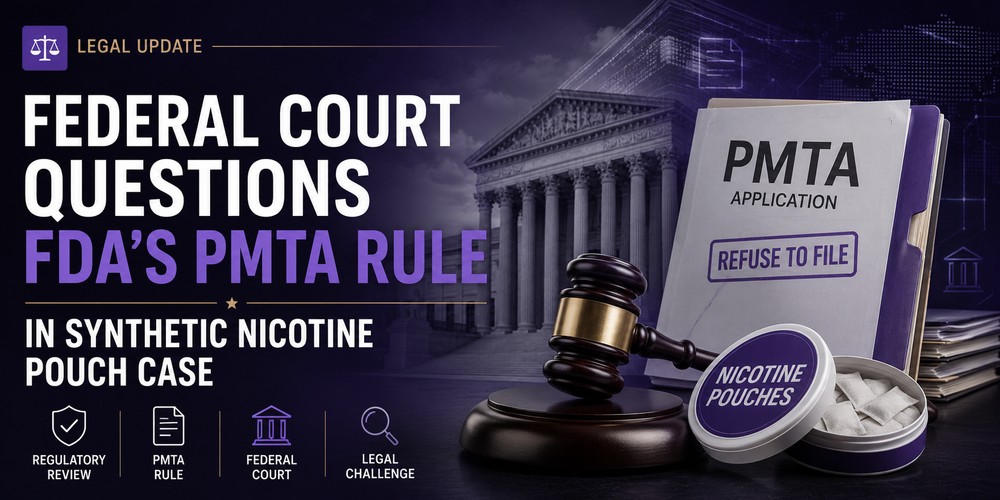
Federal Court Questions FDA's PMTA Rule in Synthetic Nicotine Pouch Case
Posted by Alli Boughner on Jul 28th 2026
A recent federal court ruling could have significant implications for small manufacturers of synthetic nicotine products navigating the FDA's premarket tobacco application (PMTA) process.
In Zest Brands LLC v. FDA, the U.S. District Court for the Middle District of Florida temporarily blocked the FDA's Refuse to File (RTF) determination against one manufacturer's synthetic nicotine pouch applications after concluding the company is likely to succeed on claims that the agency violated both the Regulatory Flexibility Act (RFA) and the Administrative Procedure Act (APA) when adopting its 2021 PMTA rule.
While the decision applies only to the plaintiffs in this case, it raises important questions about how the FDA evaluated the economic impact of its PMTA regulations on small businesses.
What Is a Refuse to File (RTF) Order?
Before the FDA reviews the scientific merits of a PMTA, it first determines whether the application contains all of the information required to proceed.
If the agency concludes that the submission is incomplete, it may issue a Refuse to File (RTF) determination.
An RTF ends the review process before the FDA evaluates whether the product is appropriate for the protection of public health.
In this case, the FDA issued an RTF letter to Zest Brands LLC, manufacturer of ZEO Universe synthetic nicotine pouches, on January 30, 2026, concluding the company's PMTAs did not satisfy filing requirements.
Because the applications were refused before substantive review, the company challenged both the RTF determination and the regulatory framework underlying it.
Why the Court Took Issue With FDA's Rulemaking
At the center of the dispute is the Regulatory Flexibility Act, a federal law requiring agencies to evaluate how new regulations affect small businesses.
When issuing regulations, agencies generally must either:
- Prepare a Regulatory Flexibility Analysis evaluating impacts on small entities, or
- Certify that the rule will not have a significant economic impact on a substantial number of small businesses and explain the basis for that conclusion.
When FDA finalized its 2021 PMTA Rule, it chose the second option.
The agency argued that the costs associated with preparing PMTAs had already been evaluated during the 2016 Deeming Rule, rather than as part of the 2021 regulation.
The court, however, questioned that reasoning.
According to the order, FDA's own analysis accompanying the 2016 Deeming Rule acknowledged that it could not quantify PMTA preparation costs for several categories of novel tobacco products, including products that were not yet subject to FDA authority at the time—such as synthetic nicotine products.
The court concluded the plaintiffs had made a substantial showing that FDA's certification was likely neither reasonable nor adequately explained.
In particularly strong language, the court stated that a certification that is "facially false does not have the force of a certification."
PMTA Costs Were Central to the Decision
The court also considered evidence regarding the cost of preparing PMTAs.
Expert testimony presented by the plaintiffs estimated that completing a PMTA may cost between $3 million and $13 million, particularly when clinical studies are included.
The court noted this testimony appeared inconsistent with FDA's earlier statements in the Deeming Rule, where the agency suggested randomized clinical trials generally would not be expected for PMTA submissions.
Although the court did not decide whether those estimates are ultimately correct, it found the evidence sufficient to support the plaintiffs' request for temporary relief while litigation continues.
The Court's Order Is Limited
The ruling does not invalidate the FDA's PMTA framework.
Instead, the court temporarily stayed the specific RTF determination issued to the plaintiffs while the lawsuit proceeds.
The court also emphasized several important limitations:
- The decision applies only to the plaintiffs.
- It applies only to the synthetic nicotine pouch products involved in the lawsuit.
- It does not extend to ENDS, e-liquids, or other tobacco products.
- The products still require FDA marketing authorization before they may be lawfully marketed.
In other words, this decision should not be interpreted as broadly changing FDA requirements for other manufacturers.
FDA Has Already Appealed
FDA has appealed the ruling to the U.S. Court of Appeals for the Eleventh Circuit, meaning the litigation is far from over.
The appellate court will now determine whether the district court correctly concluded that the plaintiffs were likely to succeed on their Regulatory Flexibility Act and Administrative Procedure Act claims.
The outcome could influence how courts evaluate future challenges involving PMTA procedures for novel tobacco products.
Why This Matters for the Industry
Although narrow in scope, the case highlights ongoing legal scrutiny surrounding FDA's PMTA regulations and the practical challenges facing smaller manufacturers.
For companies developing synthetic nicotine products, the decision serves as a reminder that procedural issues surrounding FDA rulemaking remain an active area of litigation alongside scientific review of tobacco products.
While it remains unclear whether the plaintiffs will ultimately prevail, the case illustrates how regulatory requirements themselves—not just individual marketing decisions—can become the subject of judicial review.
Looking Ahead
As FDA's appeal moves forward, manufacturers should continue monitoring developments closely.
Any future court decisions could provide additional clarity regarding the agency's obligations when adopting regulations that affect small businesses and whether portions of the PMTA framework may face additional legal challenges.
For now, the ruling offers only limited relief to the plaintiffs involved, but it represents another significant chapter in the continuing evolution of FDA tobacco regulation.
Sources
- FDA Premarket Tobacco Product Applications: https://www.fda.gov/tobacco-products/market-and-distribute-tobacco-product/premarket-tobacco-product-applications
- Regulatory Flexibility Act (U.S. Small Business Administration): https://advocacy.sba.gov/regulatory-flexibility-act/
- Administrative Procedure Act (U.S. Department of Justice): https://www.justice.gov/jm/jm-36-000-civil-resource-manual-36-administrative-procedure-act
- Middle District of Florida docket (Zest Brands LLC v. FDA): https://www.courtlistener.com/ (search Zest Brands LLC v. FDA)
- Eleventh Circuit Court of Appeals: https://www.ca11.uscourts.gov/