


South Carolina Vape Tax Starts October 1, 2026: B2B Guide
Posted by Alli Boughner on Sep 8th 2026
South Carolina vape businesses have another major compliance change coming this fall.
The South Carolina Department of Revenue (SCDOR) has issued its Nicotine Vapor Products Tax Notice explaining implementation of the state's new tax created under House Bill 4303. Beginning October 1, 2026, South Carolina will begin enforcing a new tax on vapor products and electronic cigarettes containing nicotine.
For manufacturers, distributors, wholesalers and retailers doing business in South Carolina, the important part isn't just the new tax rate. Businesses need to understand who is responsible for paying it, when a retailer becomes responsible, and what needs to happen before October 1.
Here's what the industry needs to know.
How Much Is South Carolina's New Vape Tax?
The new Nicotine Vapor Products Tax is $0.05 per milliliter of consumable nicotine liquid solution or other nicotine-containing material that is depleted as a vapor product.
That means the tax is based on the amount of nicotine-containing liquid in the product — not the wholesale or retail price of the device.
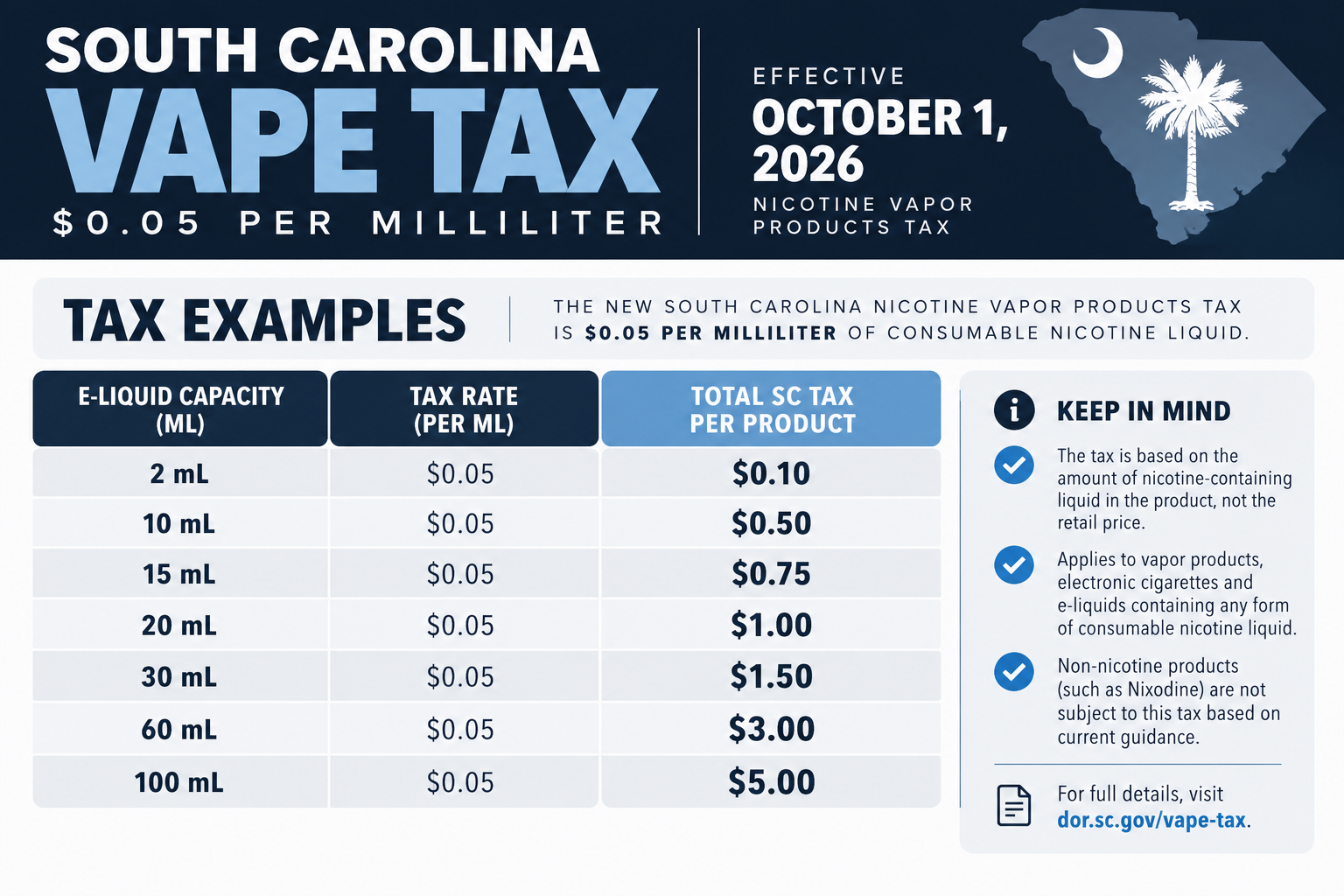
So, for example, a 20mL disposable containing nicotine would generate $1.00 in South Carolina nicotine vapor product tax.
For a distributor moving thousands of units, however, those seemingly small per-unit amounts can add up quickly.
What About Nixodine Products?
One important distinction under South Carolina’s new tax is that it specifically applies to consumable nicotine liquid or other material containing nicotine. Nixodine products are formulated without nicotine, so based on the language in SCDOR’s current guidance, Nixodine does not appear to be subject to the new $0.05-per-milliliter Nicotine Vapor Products Tax.
Who Is Responsible for Paying the Tax?
This is probably the most important part for businesses to understand.
According to SCDOR, responsibility for filing and paying the tax falls on the first person who purchases or sells vapor products, electronic cigarettes or e-liquids containing consumable nicotine liquid in the applicable South Carolina distribution chain.
SCDOR specifically identifies several types of businesses that may be responsible:
- In-state wholesalers, distributors and manufacturers first receiving nicotine vapor products in South Carolina.
- Out-of-state wholesalers, distributors and manufacturers selling and distributing products to South Carolina retailers or consumers.
- Retailers purchasing untaxed products from an out-of-state distributor or manufacturer.
- Retailers manufacturing or mixing their own nicotine e-liquid, including house-made e-liquid sold to consumers.
- Vending machine operators purchasing and selling untaxed products.
In other words, this isn't automatically a tax that every retailer independently pays on every product it sells.
The key question is whether the tax has already been paid earlier in the distribution chain.
What Does This Mean for South Carolina Vape Shops?
For retailers, knowing whether inventory is tax-paid or untaxed is going to become extremely important.
If a South Carolina vape shop purchases nicotine vapor products from a distributor that has already handled the South Carolina tax obligation, the retailer isn't necessarily the party responsible for paying that tax again.
But if that same retailer purchases untaxed inventory from an out-of-state supplier, SCDOR specifically identifies the retailer as a party that may be responsible for filing and paying the tax.
That makes supplier communication and documentation particularly important.
Before October 1, retailers should be asking their suppliers:
Are the products you're shipping to me South Carolina tax-paid?
Businesses may also need to review invoices and internal inventory procedures so they can distinguish between inventory on which the tax has already been handled and inventory for which they are responsible.
Out-of-State Distributors Can't Ignore This Tax
This is an especially important detail for B2B suppliers shipping into South Carolina.
SCDOR specifically includes out-of-state wholesalers, distributors and manufacturers selling and distributing to retailers or consumers in South Carolina among the businesses that can have responsibility for the tax.
So being located outside South Carolina doesn't automatically remove a business from the new tax requirements.
Companies currently shipping nicotine vapor products into the state should review whether they need to register before continuing South Carolina sales after the October 1 implementation date.
What About Vape Shops That Make Their Own E-Liquid?
South Carolina also specifically addresses house-made e-liquid.
Retailers that manufacture or mix e-liquid containing consumable nicotine liquid for sale to consumers are included among the businesses responsible for the tax.
That's important for traditional vape shops that still mix their own bottled e-liquid.
These businesses shouldn't assume the tax only applies to commercially manufactured disposables, prefilled pods or bottled juice received from a distributor.
Businesses Need a New Nicotine Vapor Products Tax Account
Businesses subject to the tax will need to register for a Nicotine Vapor Products Tax account through SCDOR's MyDORWAY system.
According to the notice, the Business Tax Application for the new account will become available September 24, 2026.
There is no cost to establish the new tax account.
Businesses that already hold a Cigarette Tax Stamps or Other Tobacco Products account aren't automatically finished, either. SCDOR says those businesses will receive a new license incorporating the Nicotine Vapor Products Tax account after they register for it.
That leaves businesses with a fairly short window between registration opening on September 24 and tax collection beginning October 1.
Monthly Returns Will Be Required
Registration isn't the end of the compliance obligation.
Businesses responsible for the tax must use MyDORWAY to file monthly returns and pay the tax due.
The tax begins October 1, and the first return covering October 2026 is due November 20, 2026.
Companies should therefore begin preparing their accounting and inventory systems now to track the milliliters of taxable nicotine-containing products for which they are responsible.
For businesses carrying hundreds or thousands of SKUs with different e-liquid capacities, accurate product data will be essential.
Does the Tax Apply to Non-Nicotine Vapor Products?
Based on SCDOR's September 2 notice, the new tax specifically applies to vapor products and electronic cigarettes containing nicotine, and the tax itself is calculated on consumable nicotine liquid or other nicotine-containing material depleted during use.
That distinction matters as the market expands into zero-nicotine and other alternative formulations.
Businesses shouldn't automatically assume every product that happens to use vapor hardware is subject to this particular tax. Product ingredients and the statutory definitions will matter.
What Vape Businesses Should Do Before October 1
With enforcement beginning October 1, businesses selling into South Carolina don't have much time to prepare.
Manufacturers, distributors and retailers should determine where they sit in the distribution chain and who is responsible for the tax on each product. Businesses that are responsible should register for the new account once applications become available September 24, make sure product e-liquid capacities are correctly recorded in their systems, and establish procedures for tracking taxable inventory and monthly reporting.
Retailers should also communicate with suppliers to determine whether products are arriving South Carolina tax-paid or untaxed. That distinction could determine who ultimately has the filing and payment obligation.
Another Compliance Requirement for South Carolina's Vape Industry
South Carolina businesses have already spent considerable time adapting to changing vapor regulations. Beginning October 1, they will have a new tax system to manage as well.
The $0.05-per-milliliter rate may sound relatively small on an individual product, but the compliance requirements extend far beyond adding a few cents to a sale.
Businesses need to know who owes the tax, whether incoming inventory has already been taxed, how many taxable milliliters they're handling, whether they need a new SCDOR account, and when their monthly returns are due.
The biggest takeaway for South Carolina vape businesses is simple: don't wait until October 1 to figure out where your tax responsibility begins.
SCDOR's registration application opens September 24, tax collection begins October 1, and the first monthly return is due November 20.
For additional guidance, SCDOR directs businesses to its vape-tax information page and lists TobaccoTax@dor.sc.gov for questions about the new tax.