
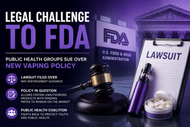
Public Health Groups Sue FDA Over New Enforcement Policy for Vapes and Nicotine Pouches
Posted by Alli Boughner on Jul 16th 2026
The U.S. Food and Drug Administration's revised enforcement policy for unauthorized vaping products and nicotine pouches is now facing its first major legal challenge.
A coalition of national public health organizations, pediatricians, parents, and advocacy groups has filed a lawsuit in federal court seeking to overturn the FDA's May 2026 enforcement guidance, arguing the agency exceeded its legal authority by allowing certain unauthorized products with pending premarket tobacco applications (PMTAs) to remain on the market under a lower enforcement priority.
The case could have significant implications for manufacturers, retailers, and the future of FDA tobacco enforcement.
What Is the Lawsuit About?
Filed in the U.S. District Court for the District of Maryland, the lawsuit challenges the FDA's May 2026 guidance titled "Enforcement Priorities for Certain New Tobacco Products Marketed Without Premarket Authorization."
The guidance did not authorize new vaping or nicotine pouch products for sale. Instead, it outlined how the FDA intends to prioritize enforcement resources.
Under the policy, the agency generally does not intend to prioritize enforcement against certain unauthorized ENDS products and nicotine pouches if:
- A PMTA has been accepted and filed by the FDA.
- The application remains under active review.
- The product does not include characteristics the agency considers especially appealing to youth, such as toy-like designs or cartoon imagery.
The products covered by the guidance remain unauthorized under federal law; the policy simply addresses how the FDA intends to allocate its enforcement efforts.
Who Filed the Lawsuit?
The plaintiffs include several prominent public health organizations, including:
- Campaign for Tobacco-Free Kids
- American Academy of Pediatrics
- American Cancer Society Cancer Action Network
- American Heart Association
- American Lung Association
- Truth Initiative
- Parents Against Vaping
The lawsuit also includes a pediatrician and a parent who allege harm related to youth nicotine use.
What Are the Plaintiffs Arguing?
The complaint raises several legal challenges to the FDA's enforcement guidance.
Among them, the plaintiffs argue that:
- The FDA exceeded its authority under the Family Smoking Prevention and Tobacco Control Act by allowing products without marketing granted orders to remain on the market.
- The agency violated the Administrative Procedure Act by issuing the guidance without first seeking public comment.
- The FDA acted arbitrarily by changing its previous enforcement approach without sufficient explanation.
- Publishing a list of products eligible for lower enforcement priority could encourage continued sales of unauthorized products.
The plaintiffs are asking the court to invalidate the guidance.
Why This Policy Matters
The May guidance marked a notable shift in how the FDA approaches enforcement.
Rather than treating every unauthorized product the same, the agency indicated it would focus enforcement resources on products it considers the greatest public health concern, including:
- Products with no PMTA on file.
- Counterfeit products.
- Products designed to appeal to youth.
- Manufacturers engaged in deceptive or unlawful practices.
The guidance also states that it does not create legally enforceable rights or obligations and instead reflects the agency's current enforcement priorities.
Potential Industry Impact
Although the lawsuit is still in its early stages, the outcome could influence how the FDA manages enforcement while PMTA reviews remain pending.
If the guidance is upheld, manufacturers with qualifying pending applications may continue operating under the agency's current enforcement priorities.
If the court sets aside the guidance, the FDA could face pressure to revisit its enforcement approach or adopt a different framework for products awaiting PMTA decisions.
For retailers and distributors, any changes to enforcement priorities could affect product availability and compliance planning in the months ahead.
What Happens Next?
The lawsuit will now move through the federal court system, where the court will determine whether the FDA acted within its statutory authority when issuing the May 2026 guidance.
Until then, the FDA's current enforcement policy remains in effect.
MiPod Wholesale Will Continue Monitoring the Case
Federal tobacco regulation continues to evolve through both agency action and litigation. As this case progresses, it may shape how the FDA balances enforcement priorities while thousands of PMTAs remain under review.
MiPod Wholesale will continue tracking this lawsuit and other major regulatory developments, providing updates that help retailers and industry partners stay informed about changes affecting the vapor and nicotine pouch markets.