

Major Fifth Circuit Win: Court Vacates FDA Marketing Denial Orders for Flavored ENDS
Posted by Alli Boughner on Aug 24th 2026
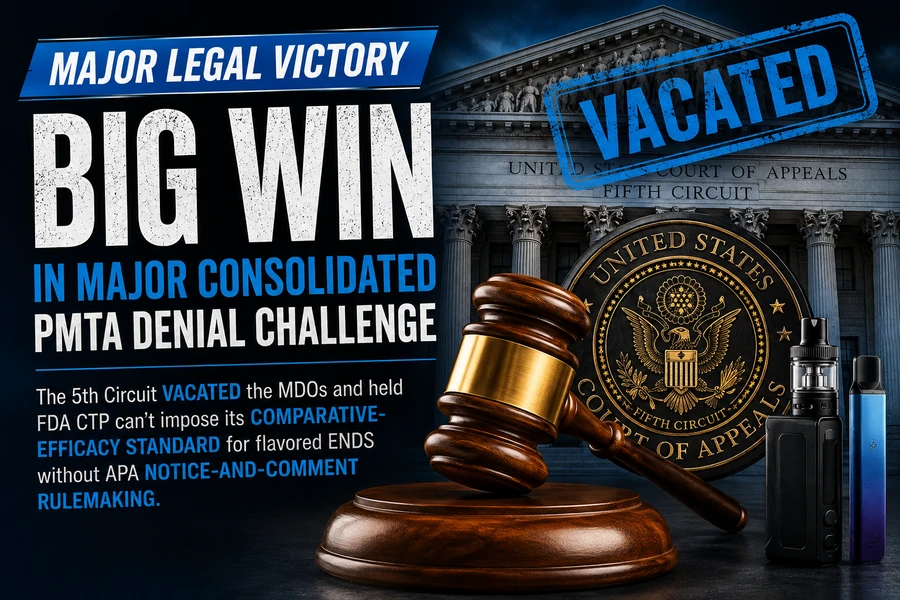
The U.S. Court of Appeals for the Fifth Circuit handed the vapor industry a major legal victory on August 19, 2026, vacating FDA marketing denial orders (MDOs) challenged by several vapor companies and sending the applications back to the agency.
At the center of the case was FDA's comparative-efficacy standard for flavored electronic nicotine delivery system (ENDS) products.
The court held that FDA could not impose that standard as a binding rule across flavored ENDS applications without first going through the notice-and-comment rulemaking process required by the Administrative Procedure Act (APA).
In other words, the issue wasn't simply whether FDA can consider comparative evidence when reviewing a PMTA.
The issue was how FDA created and imposed that requirement.
And according to the Fifth Circuit, FDA crossed the line.
What Is the Comparative-Efficacy Standard?
Under the Tobacco Control Act, manufacturers seeking authorization for a new tobacco product must demonstrate that marketing the product would be appropriate for the protection of the public health (APPH).
For non-tobacco-flavored ENDS, FDA developed a much more demanding standard.
Applicants were effectively expected to provide evidence demonstrating that their flavored products offered a greater benefit to adult smokers than tobacco-flavored ENDS — generally through comparative evidence capable of showing an added switching or cessation benefit.
That requirement became enormously important in FDA's review of flavored vapor applications.
According to the Fifth Circuit's opinion, FDA has issued MDOs covering more than 1.2 million flavored ENDS products while authorizing only a tiny fraction of flavored products.
The petitioners argued that this wasn't simply FDA exercising discretion while reviewing individual applications.
They argued that FDA had created a rule.
The Fifth Circuit agreed.
The Court: FDA Created a Binding Rule Behind Closed Doors
The court looked closely at FDA's internal policies and memoranda governing how reviewers handled flavored ENDS applications.
Its conclusion was significant.
FDA's comparative-efficacy policy wasn't merely guidance that reviewers were free to consider differently depending on an individual PMTA.
It effectively bound FDA reviewers to the same position across an enormous number of applications.
The court explained that the policy constrained reviewers from considering individual PMTAs differently and had been developed prospectively through internal agency policymaking.
That distinction mattered.
Agencies have considerable ability to develop policy through individual adjudications. But when an agency establishes a binding rule that applies prospectively to an open-ended group of regulated businesses, the APA generally requires a public rulemaking process.
The Fifth Circuit held that FDA had instead used informal adjudication to impose a substantive rule while avoiding that process.
Why Notice and Comment Matters
Notice-and-comment rulemaking isn't just paperwork.
The process requires an agency to publicly propose a rule, explain what it intends to do, allow affected parties to submit comments and evidence, consider those comments, and respond before adopting a final rule.
That means manufacturers, retailers, scientists, consumers and other affected parties have an opportunity to challenge assumptions and provide evidence before a new binding regulatory standard takes effect.
The Fifth Circuit found that FDA's approach denied affected parties that opportunity.
The court wrote that FDA had developed its policy through internal memoranda and then applied it prospectively to PMTA applicants.
Rather than allowing the regulated industry to participate in developing such a consequential standard, FDA effectively established the policy internally and applied it through individual product decisions.
That, the court held, violated the APA.
The Scale of FDA's Flavored ENDS Denials Mattered
The numbers discussed in the opinion are difficult to ignore.
The court noted that FDA had issued MDOs for more than 1.2 million flavored ENDS products.
Meanwhile, FDA had received applications covering more than six million ENDS products, while only 45 ENDS products had received authorization as of the figures cited by the court.
The court also pointed to the extremely small percentage of flavored products that had successfully made it through FDA's process.
Those numbers helped support the petitioners' argument that the comparative-efficacy policy wasn't simply one factor FDA occasionally considered.
It was functioning as an across-the-board regulatory requirement.
An Important Distinction From the Supreme Court's Wages & White Lion Decision
This case is especially important following the Supreme Court's 2025 decision in FDA v. Wages & White Lion Investments.
The Supreme Court rejected the argument that FDA had acted arbitrarily and capriciously by changing its position regarding what evidence flavored ENDS applicants would need.
But the Fifth Circuit explained that the issue before it here was different.
The petitioners weren't simply arguing that FDA changed the rules during the PMTA process.
They argued that the comparative-efficacy standard itself operated as a substantive rule that required APA notice and comment.
The Fifth Circuit concluded that the Supreme Court's Wages decision did not foreclose that separate procedural challenge.
That distinction proved critical.
The Fifth Circuit Had Left This Question Open Just Two Months Ago
The ruling is also notable because of the Fifth Circuit's June 2026 decision in VDX Distro v. FDA.
There, the court rejected an argument that FDA's comparative-efficacy standard constituted a "tobacco product standard" requiring rulemaking under the Tobacco Control Act.
But that case did not resolve whether FDA's across-the-board use of comparative efficacy violated the APA's separate notice-and-comment requirements.
In fact, the court expressly left that issue for another day.
That day has now arrived.
In the August 19 decision, the Fifth Circuit held that FDA's implementation of the standard amounted to a substantive rule subject to the APA's procedural requirements.
What Happens to the MDOs?
The Fifth Circuit granted the petitions for review, vacated the challenged MDOs and remanded the matters to FDA.
That does not mean the court granted marketing authorization to the products.
Instead, FDA must now decide how to proceed consistent with the court's ruling.
The court said FDA could reconsider the policy, adopt it through a lawful APA rulemaking process, or undertake other appropriate proceedings consistent with the opinion.
That's an important distinction for manufacturers and retailers watching this decision.
The court did not authorize flavored ENDS generally, nor did it eliminate the PMTA requirement.
It told FDA that if the agency wants to impose this kind of binding regulatory requirement, it has to follow the law when doing so.
Why This Decision Matters to the Independent Vapor Industry
For years, independent vapor manufacturers have argued that FDA's PMTA process created requirements that were never clearly established through public rulemaking and then used those requirements to deny enormous numbers of flavored products.
This decision directly addresses one of those complaints.
The ruling doesn't guarantee authorization for any flavored product.
But it reinforces something fundamental to the regulatory process:
An agency cannot avoid rulemaking requirements simply by creating a binding standard internally and then enforcing it application by application.
For an industry where the difference between receiving an MGO and an MDO can determine whether a product — or an entire business — survives, that procedural protection matters.
What Comes Next?
The immediate next step is remand to FDA.
The agency will now have to determine how it responds to the Fifth Circuit's ruling and how the decision affects its approach to the applications involved.
The broader implications could extend well beyond these petitioners, particularly because FDA's comparative-efficacy approach has played such a significant role in flavored ENDS PMTA reviews.
For now, the message from the Fifth Circuit is clear: FDA may regulate, but it still has to follow the procedures Congress and the APA require.
MiPod will continue following this case and other developments affecting the vapor industry as FDA determines its next steps.
Read the full Fifth Circuit opinion:
[August 19, 2026 Fifth Circuit Opinion — NicQuid, LLC et al. v. FDA]
This article is for informational purposes only and does not constitute legal advice.