
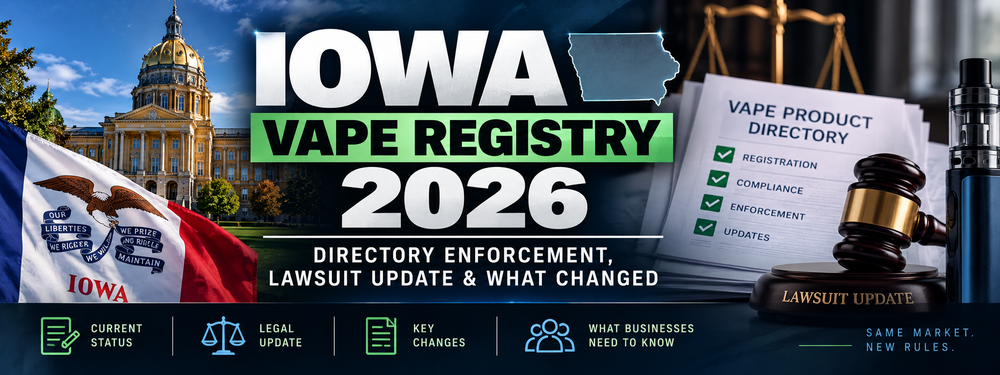
Iowa Vape Registry 2026: Directory Enforcement, Lawsuit Update & What Changed
Posted by Alli Boughner on Sep 14th 2026
Iowa's vapor product directory is back on track after more than a year of legal uncertainty — and manufacturers, distributors and retailers need to start preparing now.
The state's directory law, created by House File 2677, had been blocked by a federal court injunction since May 2025. That changed after the U.S. Court of Appeals for the Eighth Circuit vacated the preliminary injunction on July 30, 2026, clearing the way for Iowa to move forward with its vapor product directory.
The Iowa Department of Revenue has now reopened the certification process and says it expects to publish the first directory on October 15, 2026. Once that directory is published, it becomes effective — and vapor products that aren't listed may no longer be sold or offered for sale in Iowa.
For B2B businesses, here's where things stand, what happened in the lawsuit, and what manufacturers and retailers need to do next.
What Happened to the Iowa Vape Registry?
Iowa enacted HF 2677 in 2024, establishing a state directory of vapor products eligible for sale.
The law ties eligibility largely to a product's federal regulatory status. Manufacturers must certify qualifying products with the Iowa Department of Revenue, and once the directory takes effect, retailers and distributors are prohibited from selling products that aren't listed.
But the implementation hit a major roadblock.
A coalition of manufacturers, retailers, consumers and Iowans for Alternatives to Smoking & Tobacco challenged the law in federal court, arguing in part that Iowa's system was preempted by federal tobacco law.
On May 2, 2025, the U.S. District Court for the Southern District of Iowa issued a preliminary injunction blocking Iowa from establishing and enforcing the directory while the litigation continued.
That meant the directory essentially sat on hold for more than a year.
The Eighth Circuit Vacated the Injunction
The legal landscape changed significantly on July 30, 2026.
The Eighth Circuit concluded that the plaintiffs were unlikely to succeed on their federal preemption argument and vacated the preliminary injunction, sending the case back to the district court for further proceedings.
The appellate court's reasoning is important.
The court determined that Iowa's requirements fall within provisions of the federal Tobacco Control Act that preserve state authority to regulate the sale and distribution of tobacco products. In other words, the court did not agree that Iowa's directory was impermissibly taking over FDA's federal regulatory role simply because the state uses a product's PMTA status to determine whether it can be sold within Iowa.
That decision removed the legal barrier preventing Iowa from implementing the directory.
One important distinction: the July ruling concerned the preliminary injunction. It did not necessarily end every aspect of the underlying lawsuit. The case was remanded for further proceedings. But unless another court order changes things, Iowa is moving forward with implementation.
What Changed After the Court Decision?
On September 4, 2026, the federal district court dissolved its injunction, and the Iowa Department of Revenue reopened its certification process.
Manufacturers can once again submit Vapor Product Certification applications through GovConnectIowa.
The biggest change for the industry is the new implementation timeline:
Iowa currently expects to publish its first Vapor Products Directory on October 15, 2026.
The Department notes that October 15 is an estimate and could change. However, businesses should not confuse that with a grace period.
According to IDR, the directory becomes effective when it is published. At that point, only vapor products appearing on the directory may legally be sold or offered for sale in Iowa.
That makes the publication date the date retailers and distributors need to watch.
Which Vape Products Can Qualify for Iowa's Directory?
Under Iowa's current requirements, a vapor product can qualify for inclusion through one of two primary pathways.
First, a product can qualify if it has received an FDA marketing authorization or similar order under the federal premarket tobacco product requirements.
Alternatively, a product may qualify if it:
was marketed in the United States as of August 8, 2016; had a PMTA submitted to FDA on or before September 9, 2020; and the application remains under FDA review, or a final decision has not otherwise taken effect.
Manufacturers are responsible for certifying their individual products and providing documentation demonstrating that each product meets the applicable criteria.
For FDA-authorized products, that means providing the applicable marketing order. For other qualifying products, manufacturers must provide FDA documentation acknowledging receipt of the PMTA and demonstrating that a final decision has not taken effect.
What Happens to Applications Submitted Before the Injunction?
This is one of the most important updates for manufacturers that already spent time and money applying before the directory was blocked.
IDR says applications that were received and paid on or before May 2, 2025, will be reviewed for the current certification period ending July 31, 2027.
Unless the certification was denied, manufacturers with those applications do not need to submit a new application or pay another certification fee for the current period.
However, manufacturers need to make sure the information they originally submitted is still accurate.
If there has been a material change since the original application — including an FDA marketing authorization, denial or other action affecting the product — the manufacturer must notify IDR.
Applications submitted after May 2, 2025, or products that were never submitted, require a new Annual Vapor Product Certification.
How Much Does Iowa Certification Cost?
The annual certification fee is $100 per vapor product.
Certifications expire annually on July 31, and manufacturers must recertify products before August 1 to maintain continuous directory listing.
For manufacturers with large product portfolios, that means the cost and administrative workload can grow quickly because certification occurs at the individual product level rather than simply at the company or brand level.
What Does This Mean for Iowa Vape Retailers?
For retailers, the biggest change happens at the moment the directory goes live.
Once IDR publishes the directory, retailers, distributors and sub jobbers cannot sell or offer a vapor product that isn't listed for sale.
That means Iowa vape shops should begin reviewing inventory and talking with suppliers now rather than waiting for the directory to appear.
Retailers should be asking suppliers whether their products have been submitted for certification, whether existing applications remain valid, and whether the manufacturer expects the products to appear on Iowa's directory.
Most importantly, don't assume that a product is compliant simply because a manufacturer says an application was submitted.
IDR specifically states that a vapor product is not included in the directory until the Department approves its certification and publishes it on the directory.
For retailers, the published directory — not a pending application — will ultimately determine what can remain on the shelf.
Penalties Make This More Than a Manufacturer Problem
Iowa's directory isn't just a manufacturer's certification program.
Once the directory is published, selling or offering an unlisted vapor product can expose businesses to civil and criminal penalties, including fines and potential suspension or revocation of business permits. The state may also seek investigation and prosecution costs, expert-witness fees, court costs, and reasonable attorney fees.
IDR also says members of the public and law enforcement will be able to report businesses suspected of selling unapproved vapor products through GovConnectIowa.
The Department plans to work with local governments and law enforcement on retailer compliance checks.
That means retailers can't simply leave directory compliance to manufacturers.
The Lawsuit Raised a Bigger Question About State Vape Registries
Iowa litigation is significant beyond one state.
The central fight was whether a state can effectively condition the sale of vapor products on their federal PMTA status when FDA itself retains authority over the federal premarket tobacco application process.
The district court initially believed the challengers had a strong enough preemption argument to justify blocking the law. The Eighth Circuit ultimately disagreed, concluding that Iowa's restrictions fit within the authority Congress preserved for states over tobacco product sales and distribution.
For the independent vapor industry, that distinction matters.
FDA's PMTA process and Iowa's directory are technically separate from regulatory systems, but the practical reality is that Iowa is using federal regulatory status to determine which vapor products can be sold within its borders.
That leaves manufacturers and retailers navigating two regulatory layers at once — and a federal process that has already been the subject of extensive litigation over how flavored vapor PMTAs have been evaluated.
What Manufacturers Should Do Now
Manufacturers selling into Iowa should immediately determine the status of every product they intend to keep in the market.
If an application was submitted and paid by May 2, 2025, verify that IDR has the application and make sure any material changes have been reported.
If the product wasn't previously submitted — or the application falls outside IDR's rules for carrying earlier submissions forward — a new certification should be submitted through GovConnectIowa.
Manufacturers should also be communicating directly with their distributors and retail partners about which SKUs they expect to appear on the directory.
With the current publication target only weeks away, uncertainty at the manufacturer level can quickly become an inventory problem for retailers.
What Distributors and Retailers Should Do Now
Distributors and retailers should begin building their own compliance lists rather than relying solely on supplier assurances.
Once the directory is published, compare current inventory against the official Iowa list. Identify unlisted products immediately and establish internal procedures to prevent non-directory SKUs from being reordered or offered for sale.
Multi-location retailers should make sure this information reaches every store and purchasing manager.
The compliance question is about the specific product, not simply whether a particular brand appears somewhere on the directory.
Iowa's Directory Is No Longer on Hold
For more than a year, Iowa vape businesses operated with the directory's future tied up in federal court.
That period is ending.
The preliminary injunction has been vacated, IDR has reopened manufacturer certifications, and the Department currently expects the directory to become effective when it is published around October 15, 2026.
For manufacturers, that means getting certifications in order now.
For distributors and retailers, it means preparing to verify inventory against the actual published directory and understanding that a pending application won't be enough.
The underlying litigation may continue, but businesses should operate based on the law and enforcement status that exists today — not the possibility that another court decision could come later.
Iowa Department of Revenue Vapor Products Directory guidance