

Hawaii’s Vape Crackdown: New Bans, Strict FDA Requirements and Fewer Options for Adults
Posted by Alli Boughner on Nov 6th 2026
Updated November 6, 2026
Hawaii is preparing to sharply narrow the vaping products available in its market. Two enacted laws bring major changes in 2027: a state directory requiring FDA marketing authorization and a separate restriction on certain disposable devices.
For manufacturers and vape retailers, the central issue is straightforward: a pending PMTA does not qualify a product for Hawaii’s directory. The state requires an actual FDA Marketing Granted Order, or MGO.
And switching from nicotine to a nicotine alternative such as Nixodine does not create an exemption from the directory requirements.
Two Laws, Two Different Restrictions
Governor Josh Green signed both measures on July 7, 2026. Act 190, formerly HB 1573, establishes the directory framework, while Act 189, formerly SB 2175, restricts disposable electronic smoking devices.
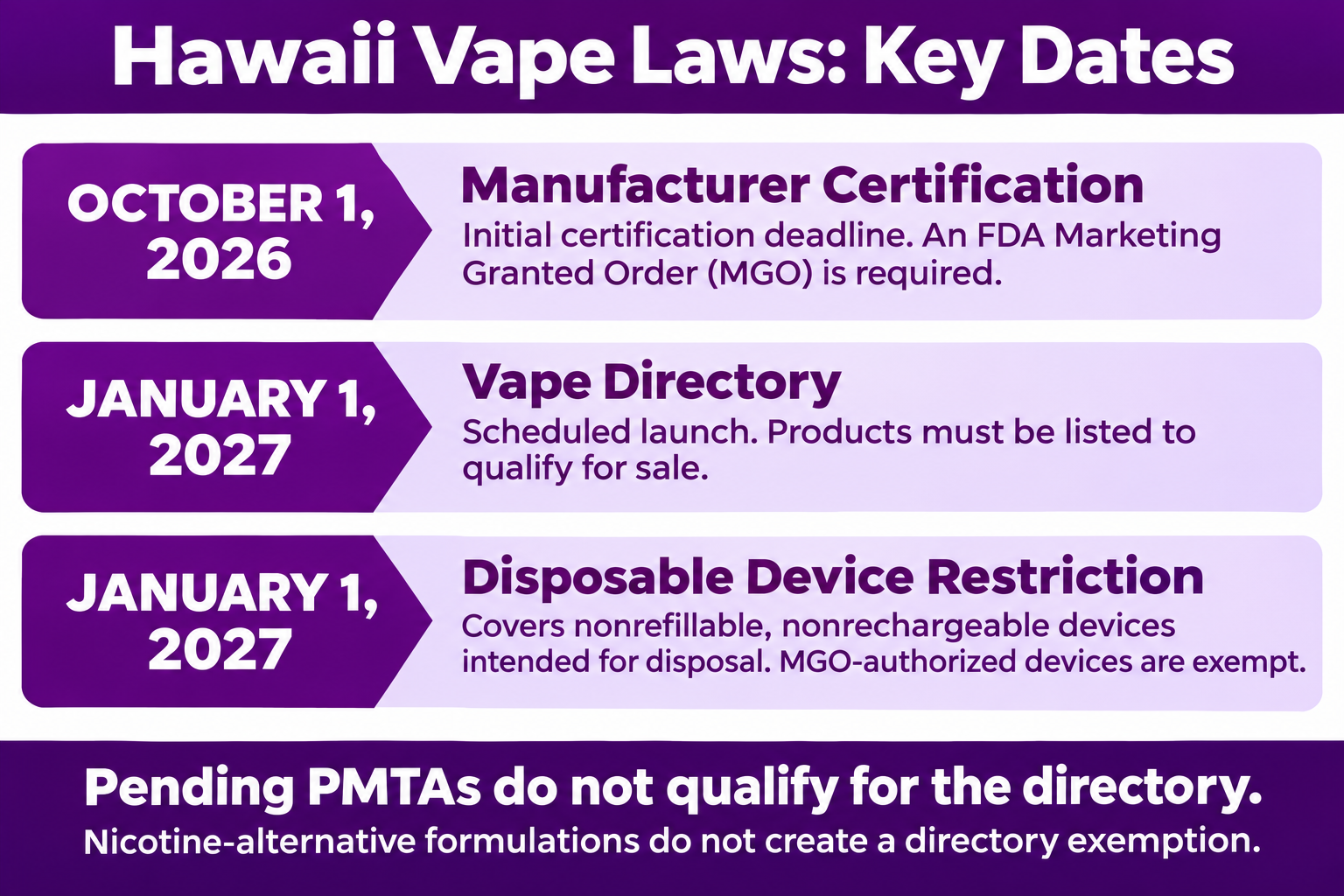
The Attorney General’s directory page confirms the certification deadline and scheduled directory launch. October 1 was the manufacturer filing deadline; January 1 is the scheduled start of directory-based sales restrictions.
An FDA Application Is Not Enough
Hawaii’s eligibility standard is unusually strict: manufacturers must certify that the specific device or e-liquid has received an MGO.
A PMTA submission, acceptance letter or application still under review does not satisfy that requirement. The Attorney General’s official notice identifies an MGO as a condition of certification and offers no pending-application pathway.
That distinction has significant consequences. Filing an application does not give a manufacturer access to this state directory. The product needs an affirmative FDA authorization, followed by state certification and listing.
For adults and the businesses serving them, Hawaii’s framework makes the FDA’s authorization decisions a direct gatekeeper for the state’s retail selection.
The Disposable Ban Has a Specific Definition
Hawaii’s disposable restriction is more precise than the phrase “disposable vape ban” suggests.
Under the enacted Act 189, the definition covers devices that are:
- Nonrefillable;
- Equipped with a non-rechargeable battery; and
- Intended to be discarded after their contents are used.
The law expressly excludes devices with an FDA MGO.
A rechargeable device does not meet that particular disposable definition, but rechargeability does not establish directory eligibility. A product outside the disposable ban can still be excluded from sale because it lacks an MGO and a Hawaii directory listing.
Nixodine and Nicotine-Free E-Liquids Are Not Exempt
Hawaii’s definitions reach beyond nicotine-containing products.
The Attorney General’s FAQs explain that the e-liquid definition covers liquids intended for electronic smoking devices whether they contain nicotine or not. The device definition likewise covers delivery of aerosolized or vaporized substances generally.
The practical implication is that replacing nicotine with Nixodine does not remove a vaping product from the directory framework. This follows from the broad definitions; it is not a separate Nixodine-specific prohibition.
A nicotine-alternative vape without the required MGO and state listing has no exemption simply because its formulation contains no nicotine.
Retailers Face Per-Item Penalties
According to the state’s enforcement notice, directory violations carry escalating penalties:
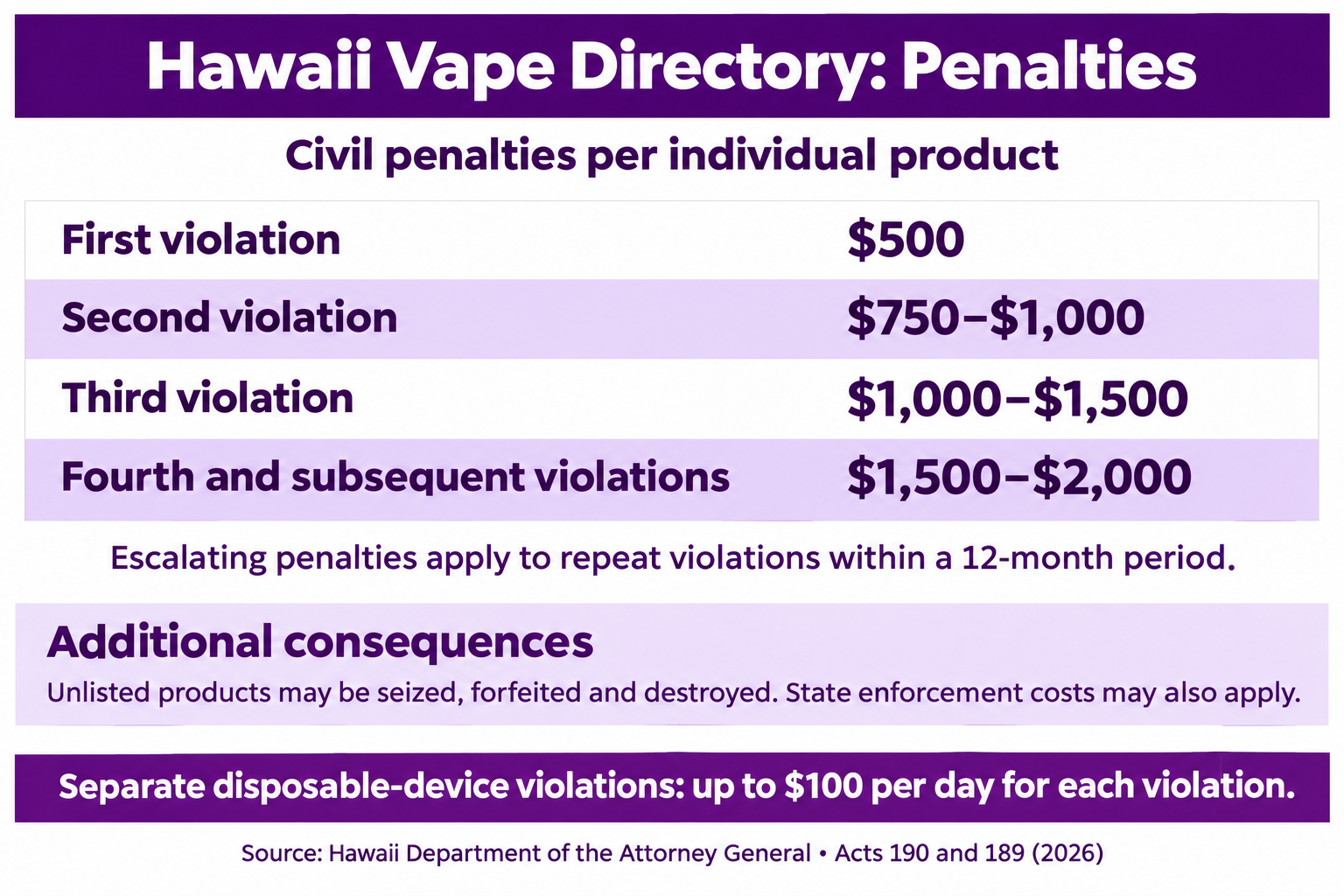
Unlisted products are also subject to seizure, forfeiture and destruction. The disposable law separately provides for fines of up to $100 per day for each violation.
What Hawaii Businesses Should Do Now
Review inventory by individual product, rather than assuming an entire brand qualifies. Ask suppliers for the applicable MGO and monitor the Hawaii directory page as implementation approaches.
Do not assume that a pending PMTA, rechargeable battery or nicotine-alternative formulation makes a product eligible. Hawaii’s new framework makes the specific product’s authorization and directory status decisive—and leaves adults with a selection shaped by which products have cleared both requirements.