

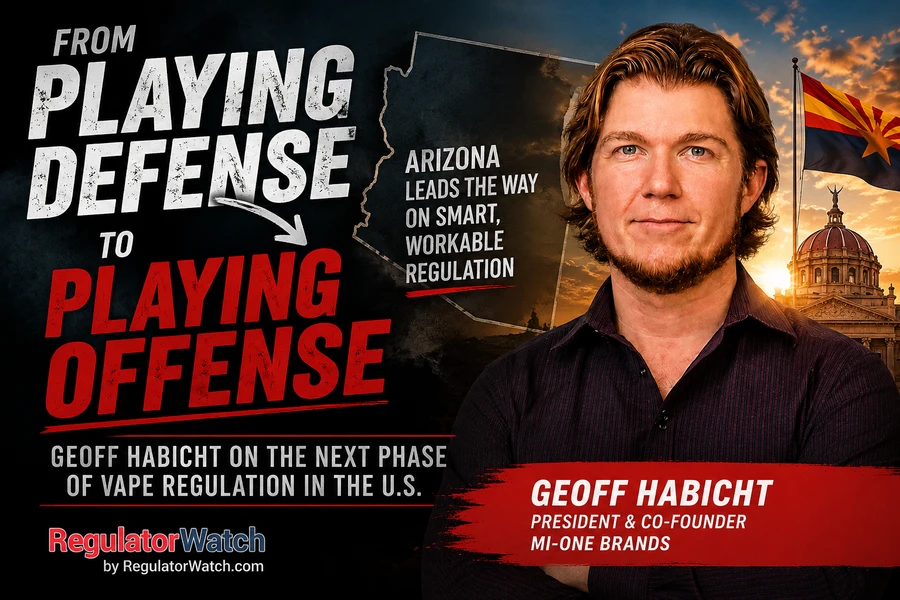
From Playing Defense to Playing Offense: Geoff Habicht on the Next Phase of Vape Regulation
Posted by Alli Boughner on Aug 25th 2026
For years, the U.S. vaping industry has largely been playing defense.
When a new registry bill appeared, the industry responded. When a flavor restriction was introduced, businesses and advocates were mobilized. When new enforcement policies emerged, manufacturers and retailers scrambled to understand what they meant.
But according to Geoff Habicht, President and Co-Founder of Mi-One Brands, that approach is beginning to change.
In a recent RegWatch interview, Habicht laid out a different strategy for the vaping industry: stop simply reacting to regulation and start helping shape it.
The Problem With Playing Defense
Habicht described the industry's experience over the past several years as a constant defensive battle.
Bills would appear at the state level — including PMTA registry proposals and flavor restrictions — and businesses would have to quickly organize, educate legislators and fight to prevent laws they believed would eliminate legitimate products from the market.
That strategy can win individual battles, but it doesn't necessarily solve the underlying regulatory problem.
He pointed to the federal PMTA process as a major source of uncertainty, noting that Mi-One Brands submitted PMTA applications for products that were accepted for review years ago and remain pending. He argued that when there is no clear, objective pathway for companies to understand what is required for authorization, businesses are left trying to navigate an uncertain system while the market continues to evolve.
The result is what Habicht described as a patchwork of regulations across the states, making compliance increasingly complicated for manufacturers, distributors, retailers and consumers.
Rethinking the Word “Illicit”
One word that has increasingly become part of the vaping regulatory debate: illicit.
Habicht argued that the term can lump together very different types of products and businesses.
His proposed distinction is straightforward: products that have never entered the PMTA process are different from products whose manufacturers have submitted applications and are actively working through that process.
Habicht explains why he believes the industry needs a clearer definition of the term “illicit” and how that could change the conversation with legislators, public-health groups and the public.
That distinction has become particularly relevant as the FDA's approach to pending PMTA products evolves.
Recent FDA guidance indicates that the agency generally does not intend to prioritize enforcement against products with pending PMTA applications that have been accepted and filed.
For Habicht, that represents a potential shift toward a more workable regulatory environment.
He also said Mi-One Brands tracks whether products have submitted PMTAs and have STN numbers. According to Habicht, approximately 90% of the unit volume of products currently on the market falls into that category.
That figure is Habicht's description of Mi-One Brands' tracking, rather than an independently verified industry statistic, but it illustrates the broader point he was making: the industry's regulatory landscape may be more complicated than the simple “authorized versus illicit” narrative suggests.
The FDA's Enforcement Discretion Could Change the Conversation
Habicht called the FDA's recent movement on enforcement discretion encouraging.
His argument is that if manufacturers have entered the PMTA process and are attempting to comply, there should be a way for those businesses to continue operating while the agency works through its backlog.
In the interview, Habicht discusses the FDA recognizing that it is behind schedule and adjusting its enforcement approach for products that have submitted PMTAs. He describes the development as the federal government moving in the right direction.
The broader goal, he said, should be an objective pathway that allows companies to understand what they need to demonstrate, meet those requirements and ultimately reach an authorization decision.
That kind of clarity could also reduce the regulatory pressure that has contributed to a fragmented state-by-state system.
What Does “Playing Offense” Actually Look Like?
Instead of waiting for another restrictive bill to appear, Habicht said the industry began asking a different question:
What if the industry worked with legislators to create the regulatory framework itself?
In Arizona, Habicht and other industry stakeholders spent significant time meeting with legislators, gathering information and making the case for a framework that could address legitimate concerns without simply eliminating the legal market.
That meant talking about youth access, enforcement, product accountability and knowing which businesses and products were operating within the rules.
It also meant changing how legislators saw the people behind the industry.
Habicht explained that the industry needed to “humanize” itself by allowing lawmakers to meet business owners, employees and the people who make up the industry.
The strategy was not about arguing that every product or business should be protected.
In fact, Habicht explicitly said there were products and practices he did not want to see in the marketplace either. He specifically pointed to products designed to appeal to youth, saying the industry itself does not want those products on the market.
His argument was that legitimate businesses should not automatically be grouped together with bad actors.
Arizona Offers a Different Path
The result, according to Habicht, was a regulatory framework that could potentially serve as a model for other states.
Rather than simply relying on a restrictive registry, the Arizona approach creates a framework for manufacturers and distributors to obtain state licenses and establishes a way to distinguish businesses that meet the requirements from those that do not.
Habicht talks about having to negotiate with people who had previously been on opposite sides of the issue and says the resulting Arizona framework could potentially serve as model legislation for the rest of the country.
Importantly, he acknowledged that neither side got everything it wanted.
But that may actually be the point.
Regulation doesn't have to mean that one side wins and the other side lose. A workable system can establish meaningful standards, enforce those standards, and still allow legitimate businesses to operate.
The Next Fight May Be About Changing Existing Laws
The conversation doesn't end with Arizona.
Habicht believes the industry's next challenge will be revisiting state registry laws that were built around older federal assumptions — particularly laws using a 2016 predicate date.
He argued that as the federal government's position evolves, states may need to reconsider portions of those laws and potentially amend them to better align with the current federal regulatory environment.
That could create an entirely different kind of advocacy battle.
Instead of fighting to stop another restrictive bill, the industry could increasingly find itself fighting to change laws that are already on the books.
From Defense to Offense
The vaping industry's regulatory challenges aren't going away.
But the strategy may be changing.
Habicht's message is that the industry now has an opportunity to use what it has learned to help create clearer, more objective, and more workable regulations.
That doesn't mean abandoning regulations.
It means pushing regulation that can distinguish between legitimate businesses and bad actors, protect youth, provide meaningful enforcement, and give manufacturers a clear pathway to compliance.
Arizona provides one example of what that approach can look like.
And if the state's framework proves successful, the industry's move from playing defense to playing offense could become one of the most important developments to watch in the next phase of U.S. vape regulation.
Watch the entire interview here.