
FDA Breaks Down the SE Predicate Review Process
Posted by Alli Boughner on Sep 23rd 2026
What Vape Businesses Need to Know From the Three Part Webinar Series
The Bottom Line
FDA’s Center for Tobacco Products has released a three-part webinar series explaining how it reviews the eligibility of predicate tobacco products in the substantial equivalence pathway. The series does not create a new route to market, lower the legal standard, or make substantial equivalence a practical alternative to the premarket tobacco product application pathway for most modern vapor products. It does, however, clarify an important gatekeeping step that now occurs before FDA begins its scientific comparison.
For applicants using a tobacco product commercially marketed in the United States on February 15, 2007 as the predicate, FDA’s Office of Compliance and Enforcement now reviews that predicate first. If the applicant cannot establish that the exact product is eligible, the Office of Science will not conduct the scientific review. That can lead directly to a Not Substantially Equivalent order.
What Is the Substantial Equivalence Pathway
Substantial equivalence, or SE, is one of the premarket pathways available under Section 910 of the Federal Food Drug and Cosmetic Act. A new tobacco product may be found substantially equivalent when it has the same characteristics as a valid predicate product, or when its different characteristics do not raise different questions of public health.
A predicate must be an individual tobacco product that either was commercially marketed in the United States on February 15, 2007, other than exclusively in test markets, or previously received an SE order from FDA. It also cannot have been rescinded, removed from the market at FDA’s initiative, or found adulterated or misbranded by judicial order.
That February 15, 2007 requirement is the central limitation for the vapor industry. The modern nicotine-vapor market had barely developed by that date, leaving most ENDS products without a realistic predicate. For that reason, the webinars are most directly relevant to traditional tobacco categories and to businesses with an established predicate chain. Vape companies should understand the process, but they should not interpret the series as FDA opening SE to today’s disposable devices, pod systems, or e-liquids.
What Changed in FDA Review
Before FDA’s SE final rule was implemented, the Office of Compliance and Enforcement and the Office of Science could review predicate eligibility and scientific equivalence at the same time. Applicants generally received one deficiency letter covering both areas.
FDA now uses a sequential process. After acceptance review, the Office of Compliance and Enforcement first determines whether a claimed pre-existing product is eligible to serve as the predicate. Only after the predicate clears that review does the application move to the Office of Science for the scientific comparison. Predicate-related communications come directly from the Office of Compliance and Enforcement, and applicants must respond to that office.
|
Stage |
FDA Office |
What Happens |
|
Acceptance review |
Office of Science |
Checks whether the SE report is complete enough to accept for review. |
|
Predicate review |
Office of Compliance and Enforcement |
Determines whether a claimed pre-existing product is eligible to serve as the predicate. |
|
Scientific review |
Office of Science |
Compares the new product with the eligible predicate and evaluates whether differences raise different public-health questions. |
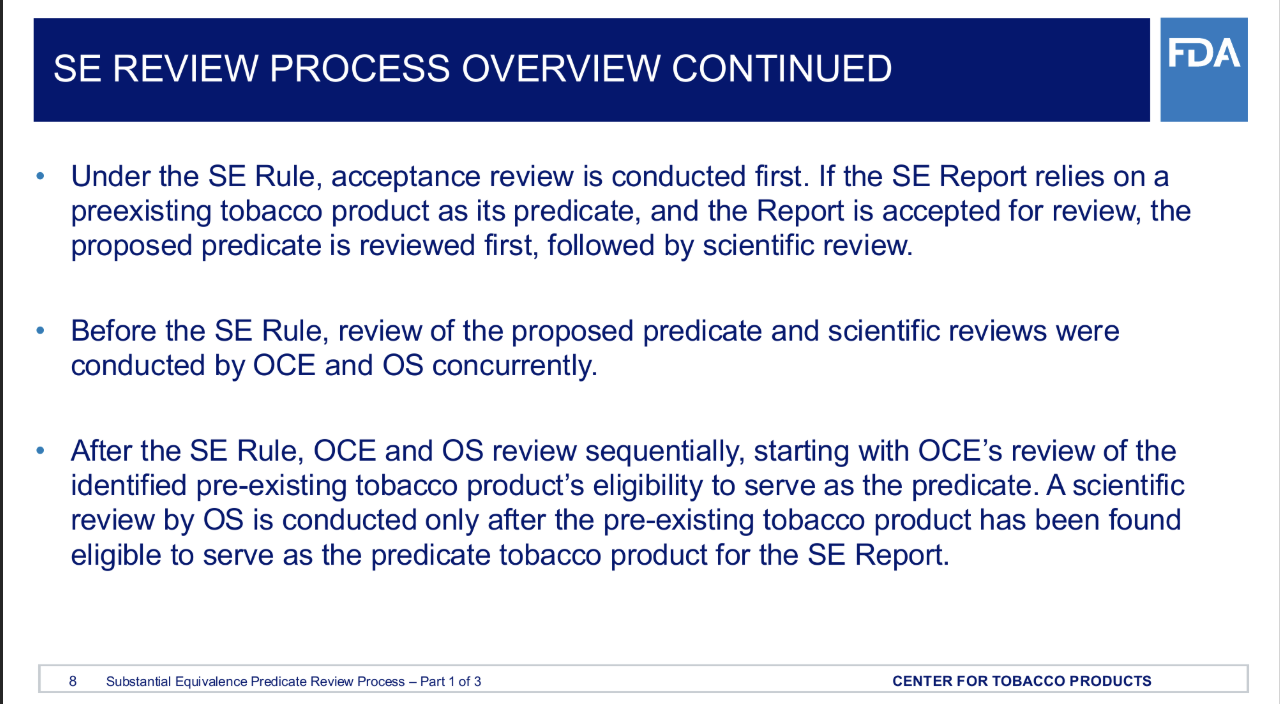
FDA explains that predicate eligibility is now reviewed before the scientific SE analysis. Source: FDA CTP, Part One, slide 8.
Two Types of Predicate Review
FDA described two ways it may verify a proposed pre-existing predicate:
- Cross-reference review. FDA verifies a prior pre-existing product determination. Older determinations may carry a GF submission tracking number, while determinations made after August 2022 generally use a PX prefix.
- Full predicate review. FDA conducts a full review when the proposed predicate does not have a prior GF or PX determination that the applicant can cross-reference.
A prior pre-existing determination can simplify the eligibility question, but it does not establish that the new product is substantially equivalent. Predicate eligibility merely allows the application to advance to scientific review and gives the new product no marketing authorization.
Forms and Product Identification Matter
FDA emphasized that applicants must use the current versions of its SE forms. Since July 6, 2025, those include Form FDA 3965 for the SE report, Form FDA 3965a for amendments and general correspondence, and Form FDA 3965b for unique identifying information about the new and predicate products. FDA stated that an improperly completed form may result in refusal to accept the application or in amendment information not being reviewed. SE correspondence must be submitted electronically.
The predicate must be identified consistently throughout the submission. Form FDA 3965b captures characteristics such as package type, quantity, length, diameter, and flavor. A mismatch as small as using one product name in the report and a different name associated with the cross-referenced GF or PX determination can trigger a request for information.
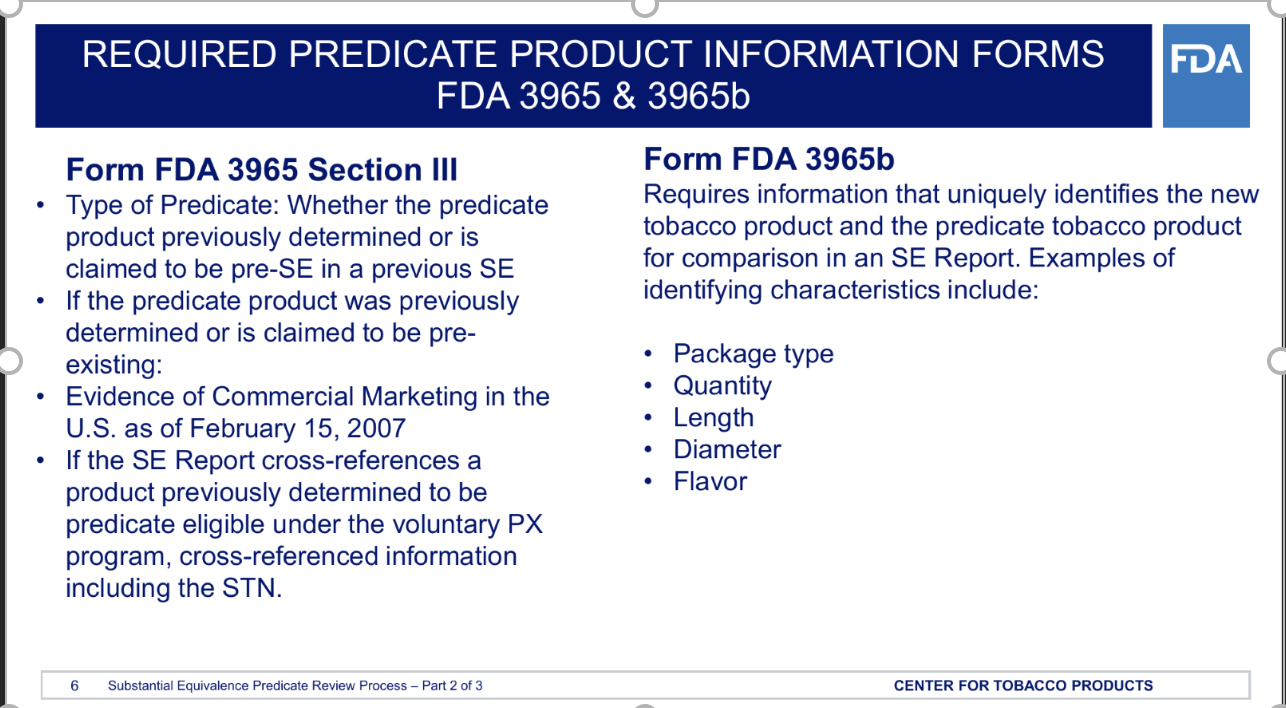
Forms FDA 3965 and 3965b require evidence and product details that identify the exact predicate. Source: FDA CTP, Part Two, slide 6.
Evidence Must Prove the Exact Product Was on the Market
Claiming that a brand or product family existed in 2007 is not enough. FDA interprets “as of February 15, 2007” to mean that the specific predicate product was commercially marketed on that exact date. The evidence must connect directly to the exact product identified in the SE report.
FDA highlighted several expectations for the evidentiary package:
- Dated records showing commercial marketing in the United States on February 15, 2007.
- A clear link between item numbers, abbreviations, symbols, or product descriptions in the records and the proposed predicate.
- Ship-from and ship-to addresses where relevant.
- English-language documents or an accompanying translation.
- A dated and signed certification from a responsible official with knowledge and authority confirming that the product was commercially marketed in the United States on the required date and was not exclusively in test marketing.
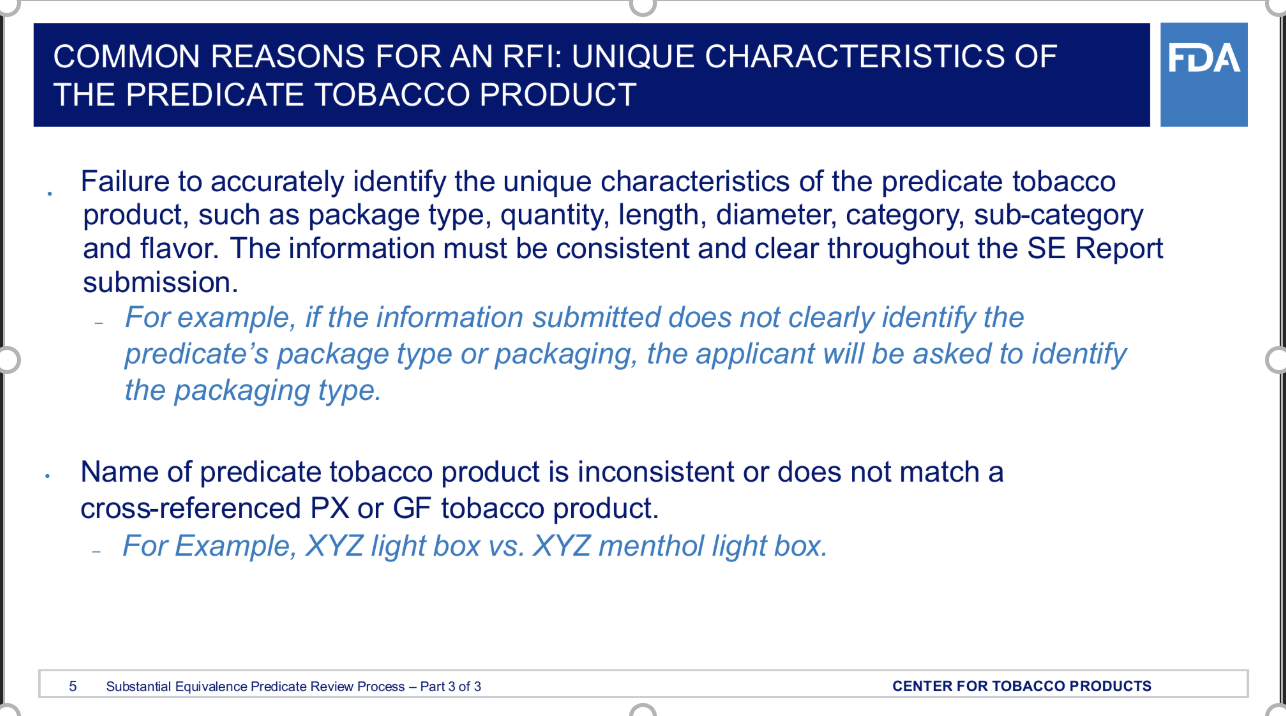
Inconsistent product names and incomplete identifying characteristics are common reasons for an FDA request for information. Source: FDA CTP, Part Three, slide 5.
Short Response Windows and Limited Extensions
During predicate review, FDA may send a narrowly focused email requesting a response within roughly seven to ten business days. More substantial deficiencies may arrive in a formal Request for Information letter, with a response generally due within 30 days of receipt. Responses should be submitted using Form FDA 3965a through CTP Portal NextGen or the FDA Document Control Center, as directed.
Applicants should not assume an extension will be available. FDA said the Office of Compliance and Enforcement rarely grants extensions, generally reserving them for circumstances outside the applicant’s control such as a natural disaster or emergency. Asking for an extension does not pause the existing deadline while FDA considers the request.
The Predicate Cannot Be Swapped After Acceptance
Once the Office of Science accepts an SE report for review, 21 CFR 1107.20(b) prevents the applicant from amending the report to change the predicate. Correcting a typographical error, supplying additional commercial-marketing evidence, or adding a missing certification may not constitute a predicate change. Identifying an entirely different product generally will.
If the original predicate fails, an attempt to replace it can result in an NSE order. The applicant may instead need to withdraw the report and submit a new one. This makes predicate selection and verification a front-end due-diligence issue, not something that can safely be fixed late in review.
Possible Outcomes
If the Office of Compliance and Enforcement finds the predicate eligible, the application advances to scientific review. That decision is not an SE order and does not authorize the new product for marketing.
If FDA is unable to determine predicate eligibility, the scientific review does not occur and the applicant can expect an NSE order. FDA listed missed deadlines, uncorrected deficiencies, and an attempted predicate change after acceptance among the possible reasons for this outcome.
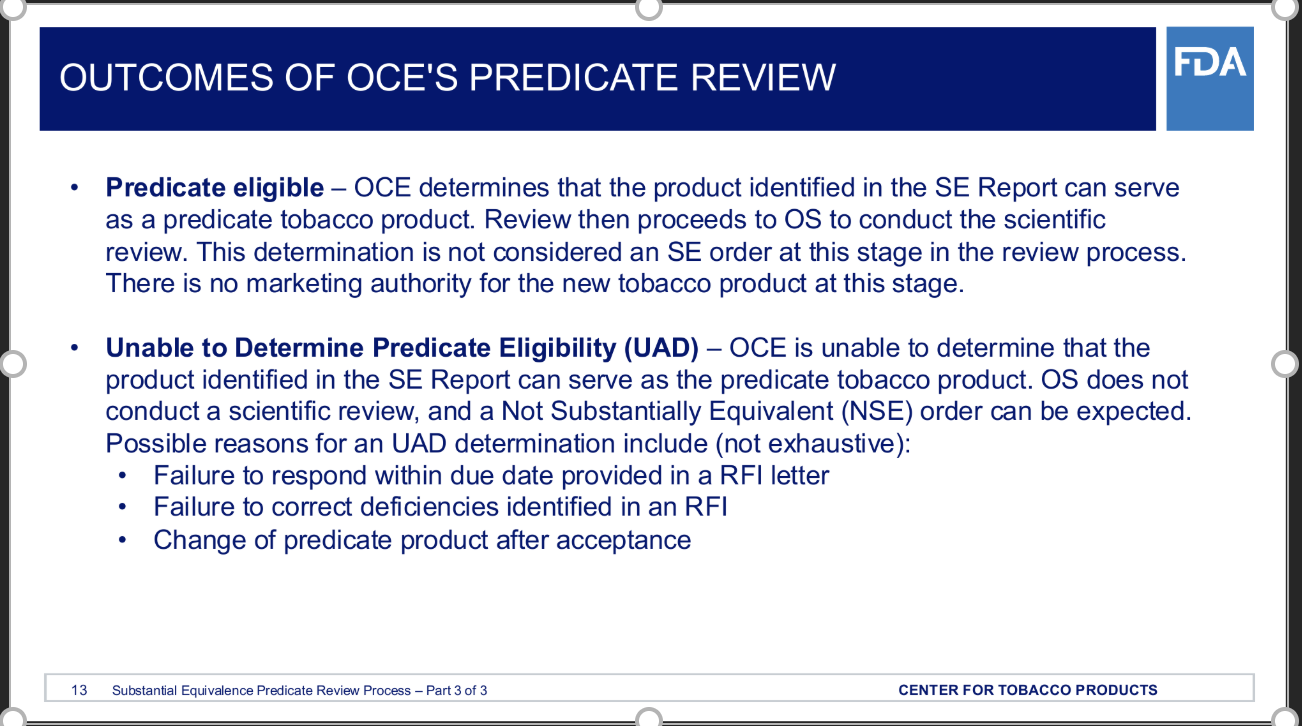
Predicate eligibility allows scientific review to begin but does not provide marketing authorization. Source: FDA CTP, Part Three, slide 13.
What Vape Businesses Should Do
- Do not treat the webinars as a change in enforcement discretion or as a substitute for PMTA authorization.
- Confirm which premarket pathway actually applies before investing in an SE report. Most modern ENDS products will not have a viable February 15, 2007 predicate.
- If relying on SE, verify the exact predicate and its evidence before filing. Brand history alone is not enough.
- Use the current FDA forms and make product names and identifying characteristics consistent across every form, exhibit, and cross-reference.
- Assign responsibility for monitoring CTP communications. A seven-to-ten-business-day email deadline can disappear quickly.
- Prepare supporting evidence and the responsible-official certification in advance. Do not count on an extension or on changing predicates after acceptance.
- Consult experienced regulatory counsel before making pathway or marketing decisions. FDA’s webinar materials are educational and do not replace case-specific legal advice.
Why This Update Still Matters to the Vapor Industry
The series does not solve the vapor industry’s larger market-authorization problem. It does show, however, how heavily FDA’s review system depends on precise product identity, complete records, procedural compliance, and strict deadlines. An application can fail before FDA ever reaches the scientific question.
For vape manufacturers and importers, the practical lesson is to avoid reading every new FDA training initiative as a broad policy shift. This series is a detailed explanation of an existing pathway and a warning about its early procedural gate. Businesses should understand it, determine honestly whether it applies to their products, and build their compliance strategy around the pathway the law and the available evidence actually support.