

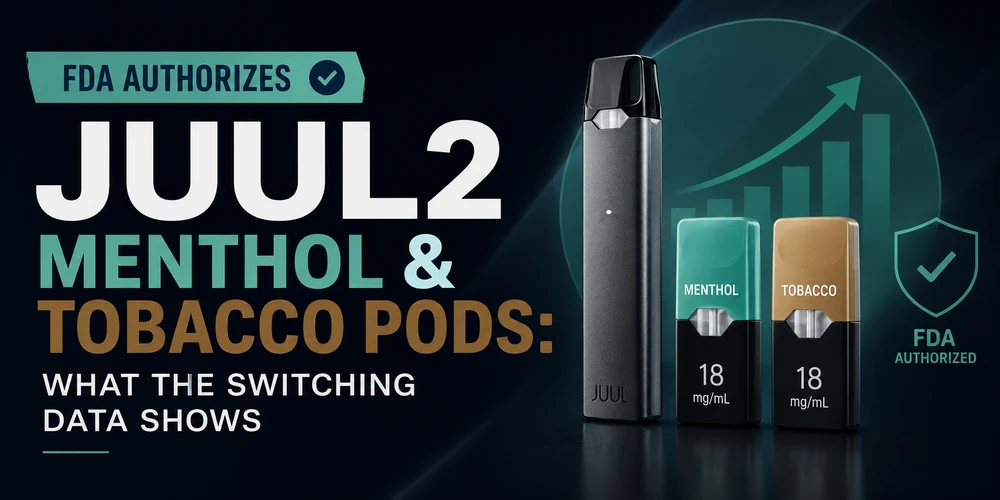
FDA Authorizes JUUL2 Menthol & Tobacco Pods: What the Switching Data Shows
Posted by Alli Boughner on Sep 1st 2026
The U.S. Food and Drug Administration has authorized three additional JUUL products through the Premarket Tobacco Product Application (PMTA) pathway, bringing the total number of FDA-authorized e-cigarette products to 48.
On August 28, 2026, FDA issued marketing granted orders for the JUUL2 device, an 18 mg/mL tobacco-flavored JUUL2 pod, and an 18 mg/mL menthol-flavored JUUL2 pod.
But beyond another round of JUUL authorizations, FDA's explanation for its decision contains something the vapor industry should be paying close attention to:
The menthol product produced higher rates of complete switching from cigarettes than the tobacco-flavored product — and FDA determined that benefit was sufficient to outweigh the risks associated with youth appeal.
That's an important acknowledgment from the agency responsible for regulating vapor products.
What Did FDA Authorize?
The three newly authorized products are all part of the JUUL2 system:
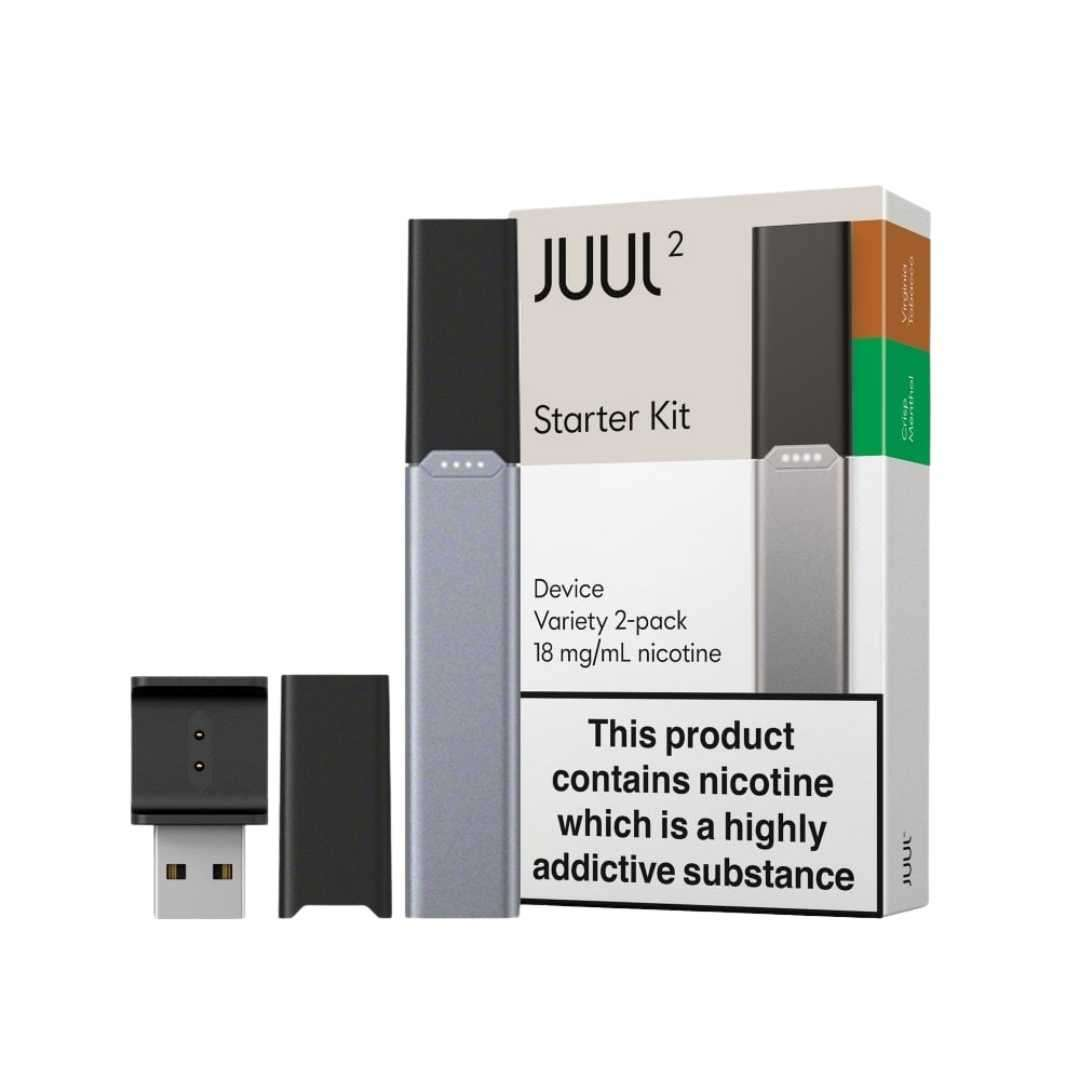
- JUUL2 e-cigarette device
- JUUL2 tobacco-flavored pod — 18 mg/mL
- JUUL2 menthol-flavored pod — 18 mg/mL
The 18 mg/mL pods contain the equivalent of approximately 1.5% to 1.6% nicotine, making them lower-strength options than the 3% and 5% JUUL pods FDA authorized in July 2025.
Under the PMTA standard, FDA must determine whether marketing a new tobacco product is appropriate for the protection of public health, considering the risks and benefits to the population as a whole.
And in this case, FDA found sufficient evidence that the products met that standard.
The Switching Data Deserves Attention
According to FDA, a substantial proportion of adult smokers participating in the research completely switched away from combustible cigarettes while using JUUL2.
At six weeks:
19.9% to 34.6% of participants using the tobacco-flavored pod had completely stopped smoking cigarettes.
For the menthol-flavored pod, that increased to 28.4% to 49.3%.
That's not a minor detail buried in the application.
FDA specifically highlighted the fact that the menthol product demonstrated a higher rate of complete switching compared with the tobacco-flavored product.
The agency also reported that adults who completely switched to JUUL2 were exposed to lower levels of harmful chemicals than they would have been had they continued smoking cigarettes.
For anyone following the debate over flavors and tobacco harm reduction, those findings should matter.
FDA Says the Benefit of Menthol Outweighed the Risk
Perhaps the most noteworthy sentence in FDA's announcement was this:
The agency determined that the additional benefit to adults who smoke was sufficient to outweigh the risks of the menthol-flavored product, including youth appeal.
That deserves some attention.
For years, much of the regulatory conversation surrounding flavored vapor products has focused almost exclusively on potential youth appeal.
Here, FDA is explicitly acknowledging the other side of that equation.
Flavor can affect adult switching.
And in this particular application, FDA determined that the increased benefit demonstrated by the menthol product outweighed its potential risks.
That doesn't automatically mean the same conclusion applies to every flavored product or every PMTA. Each application is evaluated on its own evidence.
But it does reinforce something the independent vapor industry has argued for years: flavor isn't simply a marketing characteristic. It can influence whether an adult smoker finds an alternative acceptable enough to completely leave cigarettes behind.
Complete Switching Matters
FDA also emphasized another important harm-reduction principle in its announcement: the greatest benefit comes when adults completely switch away from combustible cigarettes.
According to the agency, dual use does not provide the same degree of health benefit as completely transitioning to an e-cigarette or another lower-risk alternative.
That's an important context when discussing vapor regulation.
The goal shouldn't simply be getting smokers to occasionally use another product alongside cigarettes. The real public-health opportunity comes from providing alternatives adults will actually use instead of smoking.
And FDA's own JUUL2 data suggests product characteristics — including flavor — can influence that transition.
Another Authorization — But the Bigger PMTA Problem Remains
We welcome additional evidence recognizing the role e-cigarettes can play in moving adults away from combustible cigarettes.
But there's another side to this announcement that the independent vapor industry can't ignore.
After years of PMTA reviews involving an enormous number of vapor products, FDA says there are now just 48 authorized e-cigarette products in the United States.
That's an extraordinarily small, authorized marketplace.
And once again, a major company with significant financial and regulatory resources has successfully navigated a system that remains virtually impossible for much of the independent vapor industry to get through.
That doesn't mean JUUL shouldn't receive authorization if its applications satisfy the statutory standard.
The problem isn't that JUUL received authorization.
The problem is that after all these years, we still haven't seen a regulatory pathway that provides meaningful opportunities for responsible independent manufacturers to receive them too.
The Timing Is Especially Interesting
This authorization also arrives just days after a major Fifth Circuit decision challenging FDA's treatment of flavored ENDS applications.
In that case, the court concluded that FDA could not impose its comparative-efficacy requirement for flavored ENDS as a substantive rule without going through the Administrative Procedure Act's notice-and-comment process.
And now FDA itself is highlighting evidence showing that a flavored vapor product produced greater complete-switching rates than its tobacco-flavored counterpart.
Those are separate matters and shouldn't be conflated.
But together, they raise an increasingly important question for the agency:
What role should flavor-specific evidence actually play in evaluating vapor products intended for adult smokers?
If FDA accepts evidence that menthol provides an incremental switching benefit over tobacco flavor, the agency should be willing to fairly evaluate credible evidence demonstrating whether other flavors provide similar benefits.
That should apply regardless of whether the applicant is one of the largest companies in the market or an independent manufacturer.
A Functioning Pathway Shouldn't Be Reserved for the Biggest Players
This is ultimately where the industry conversation needs to go.
FDA says these latest authorizations represent another step toward providing adults who smoke with greater access to products that can promote switching and reduce downstream risks associated with combustible cigarettes.
We agree with that principle.
Adults who smoke should have access to alternatives that can help them move completely away from combustible cigarettes.
But 48 authorized e-cigarette products are not a diverse or competitive vapor marketplace.
If the PMTA pathway is going to fulfill its public-health purpose, it has to become a pathway that responsible manufacturers can realistically navigate.
Independent companies shouldn't be asking for a lower scientific standard.
They should be asking for a fair, transparent, and consistent one.
The Bottom Line
The JUUL2 authorization is significant for more than the addition of three products to FDA's authorized list.
FDA's own review found that substantial percentages of adult smokers completely switched to JUUL2, that those who switched experienced lower exposure to harmful chemicals than if they had continued smoking, and — perhaps most importantly — that the menthol product produced higher complete-switching rates than the tobacco product.
FDA ultimately concluded that the added benefit to adult smokers was enough to outweigh the menthol product's risks, including youth appeal.
That's a harm-reduction calculation.
And it's one FDA should be willing to make fairly when reviewing products from every manufacturer — not just the companies with the deepest pockets and greatest resources.
The independent vapor industry has spent years asking for a regulatory pathway that recognizes the continuum of risk, considers the needs of adults who smoke and evaluates products based on evidence.
FDA's latest JUUL2 decision shows that the agency can make that kind of assessment.
Now the question is whether more of the industry will ever be given a meaningful opportunity to get through the same door.